DTF vs Screen Printing: Which Is Better for Custom T-shirts?
Compare two popular T-shirt printing methods and discover which one suits your artwork, fabric, budget and order quantity.
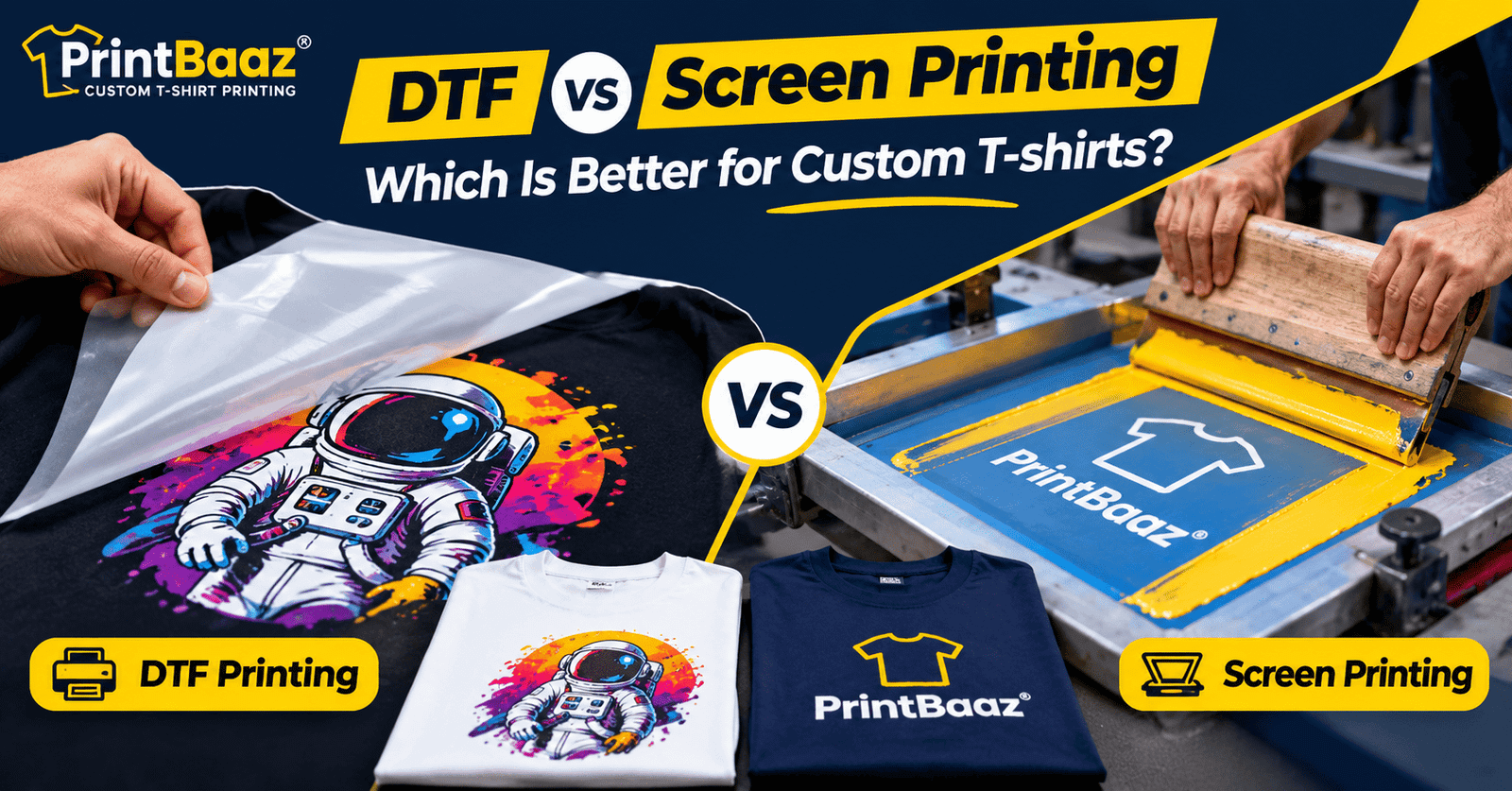
DTF vs Screen Printing is an important comparison when ordering custom T-shirts for a business, event, clothing brand or promotional campaign. Both methods can produce attractive printed apparel, but they differ in how designs are transferred onto fabric, how orders are priced and which types of artwork they handle best.
A restaurant ordering branded staff uniforms may have completely different requirements from a clothing brand producing colourful graphic T-shirts. Choosing a printing technique without considering these differences can increase costs or result in a finish that does not suit the garment.
At PrintBaaz, we offer custom T-shirt printing in Delhi for businesses, organisations, events and apparel brands. This guide explains the practical differences between DTF and screen printing so you can make a more informed decision before placing an order.
Quick Answer: DTF printing is generally better suited to detailed, multicolour artwork and smaller production runs. Screen printing is often more economical for larger orders featuring simple, repeated designs with fewer colours.
The best choice ultimately depends on your artwork, garment material, quantity and preferred print finish.
What Is DTF Printing?
DTF stands for Direct to Film. In this printing method, a digital design is printed onto a specialised transfer film using compatible inks. An adhesive powder is applied and cured before the design is transferred onto the garment using a heat press.
Unlike traditional screen printing, DTF does not require a separate physical screen for every printed colour. This makes it particularly useful for artwork containing gradients, fine details, multiple colours and complex illustrations.
DTF transfers can be applied to many cotton, polyester and blended garments, provided the transfer materials and pressing conditions are suitable for the fabric.
What Is Screen Printing?
Screen printing is a traditional apparel printing technique in which ink is pushed through a prepared mesh screen onto the garment. In conventional spot-colour printing, separate screens are generally prepared for individual colours in a design.
Once the screens are prepared, the same artwork can be reproduced across multiple garments. This production process makes screen printing a practical option for repeated designs, especially when order quantities are high.
Screen printing is commonly used for corporate logos, promotional merchandise, event T-shirts, uniforms and clothing collections. Different ink systems can produce different finishes, textures and levels of softness.
DTF Printing
- Detailed digital artwork
- Multicolour logo printing
- Gradients and illustrations
- Flexible design variations
- Small and medium production runs
Screen Printing
- Bold, repeated graphics
- Simple brand logos
- Promotional T-shirts
- Large uniform requirements
- Economical bulk production
DTF vs Screen Printing: 7 Key Differences
Comparing these seven factors will help you understand which T-shirt printing method is more suitable for your specific requirements.
Printing Cost and Setup
DTF printing generally involves less design-specific setup because individual colour screens are not required. However, the cost of film, ink, adhesive and transfer application contributes to the overall production price.
Screen printing involves initial screen preparation and setup costs. When the same design is printed on a large number of garments, those costs can be spread across the entire order.
Best choice: DTF for smaller or complex orders; screen printing for suitable high-volume, repeated designs.
Design Detail and Colour Options
DTF printing is well suited to colourful illustrations, fine lettering, detailed logos and artwork containing gradients. Digital production makes it easier to reproduce complex colour combinations without preparing separate screens for each spot colour.
Screen printing performs particularly well with bold graphics, solid colours and straightforward brand logos. Advanced screen printing techniques can also reproduce complex artwork, although they may require additional preparation and expertise.
Best choice: DTF for complex digital artwork and screen printing for bold spot-colour designs.
Print Durability and Wash Resistance
Both DTF and screen printing can provide good durability when suitable materials and correct production processes are used.
DTF durability depends on transfer quality, adhesive compatibility and heat-press application. Screen printing durability depends on ink selection, fabric compatibility and proper curing.
Washing temperature, detergents, ironing and drying habits also influence how long a printed design remains in good condition.
Best choice: Neither method is automatically more durable in every situation. Production quality and garment care matter.
Fabric Compatibility
DTF printing can be used on many cotton, polyester and blended garments, making it a flexible option for mixed apparel requirements.
Screen printing also works with a wide range of fabrics when the correct ink system is selected. Polyester garments may require particular inks or production controls to reduce colour migration and other printing issues.
Heat-sensitive fabrics and specially treated garments should be assessed before selecting either technique.
Best choice: Select the method according to the actual fabric rather than relying on the garment name alone.
Print Texture and Wearing Comfort
DTF creates a transferred layer on the surface of the garment. Smaller designs can feel comfortable, while large, solid printed areas may feel heavier or less breathable.
Screen printing can produce different textures depending on the ink system and amount of ink deposited. Certain water-based printing applications can offer a softer finish, while other ink types create a more noticeable surface layer.
Best choice: Consider the design coverage and desired finish. Request a sample when texture is especially important.
Order Quantity and Production Efficiency
DTF printing offers flexibility when an order contains several different designs, personalised graphics or smaller quantities of each artwork.
Screen printing becomes particularly efficient when the same artwork is repeated across a substantial number of garments. Once production is set up, repeated printing can be economical and consistent.
Best choice: DTF for design flexibility; screen printing for suitable repeat-production orders.
Customisation and Design Changes
DTF printing makes it easier to produce different names, graphics and artwork variations within an order because the designs are prepared digitally.
With conventional screen printing, significant artwork changes may require additional screens or production setup. This can affect the cost of orders containing many individual designs.
Best choice: DTF generally offers greater flexibility for frequently changing artwork, while screen printing is ideal for consistent repeated graphics.
DTF Printing vs Screen Printing Comparison Table
| Comparison | DTF Printing | Screen Printing |
|---|---|---|
| Printing process | Film transfer using heat press | Ink applied through mesh screens |
| Initial setup | Lower design-specific setup | Screen preparation required |
| Complex artwork | Well suited | May require advanced setup |
| Multiple colours | Flexible digital reproduction | Often requires additional screens |
| Smaller orders | Often economical | Setup may increase unit cost |
| Large repeated orders | Suitable, depending on design | Often highly economical |
| Print texture | Transfer layer on fabric | Varies by ink and application |
| Durability | Depends on transfer and application | Depends on ink and curing |
| Personalisation | Highly flexible | Less flexible for changing designs |
These comparisons describe general production characteristics. Actual pricing, turnaround time and print performance depend on the artwork, garment and production requirements.
Which Printing Method Is Better for Bulk T-shirt Orders?
When comparing DTF vs Screen Printing for bulk orders, quantity alone should not determine the final decision. The number of colours, print locations, artwork complexity and garment material can significantly influence the cost.
For example, a business ordering hundreds of T-shirts with the same one-colour logo may benefit from screen printing. A clothing brand ordering a similar total quantity divided among several colourful designs may find DTF printing more practical.
Businesses looking for bulk T-shirt printing in Delhi should share their artwork and complete order requirements before selecting a production method.
At PrintBaaz, our minimum order quantity starts from 10 pieces. We accept custom apparel orders across Delhi NCR and other locations throughout India.
Which T-shirt Printing Method Should You Choose?
Choose DTF Printing When:
- Your artwork contains multiple colours or gradients.
- You require detailed illustrations or graphics.
- Your order includes different artwork variations.
- You are producing a smaller clothing collection.
- You need flexible custom logo printing.
Choose Screen Printing When:
- You need a large quantity of identical designs.
- Your logo uses a limited number of solid colours.
- You are ordering promotional or event T-shirts.
- Reducing the per-piece cost is a priority.
- Your artwork suits conventional screen production.
If you are unsure, ask your printing supplier to assess both methods using the same garment, artwork dimensions and order quantity. Comparing equivalent specifications provides a more useful price comparison.
Common Mistakes to Avoid When Ordering Printed T-shirts
Choosing Only by the Lowest Price
A lower quotation may involve different garment quality, print dimensions or production specifications. Compare the complete order details rather than the price alone.
Providing Low-Resolution Artwork
Blurry logos and compressed images can reduce print clarity. Supply suitable high-resolution artwork or vector files whenever possible.
Ignoring Fabric and Print Placement
Fabric composition, seams, garment colour and print placement can affect the final result. Confirm these details before approving production.
Skipping Design Approval
Review artwork size, spelling, placement and colour expectations before production. For important or large orders, consider requesting a physical sample.
Frequently Asked Questions
Is DTF printing better than screen printing?
DTF printing is often better for complex, multicolour artwork and flexible production quantities. Screen printing is often better for larger orders containing simple, repeated designs.
Which lasts longer, DTF or screen printing?
Both methods can produce durable prints. Their lifespan depends on production quality, materials, fabric compatibility and garment care. There is no universal wash-life guarantee for either method.
Is DTF printing cheaper than screen printing?
DTF may be more economical for smaller quantities and complex designs. Screen printing may offer a lower per-piece cost for large orders with repeated, limited-colour artwork.
Can DTF printing be used on cotton T-shirts?
Yes. DTF printing can be applied to many cotton garments using suitable transfer materials and appropriate heat-press settings.
Is screen printing suitable for corporate logos?
Yes. Screen printing is widely used for corporate logos, promotional apparel and staff uniforms, particularly when the same design is repeated across multiple garments.
Which printing method is best for colourful T-shirts?
DTF is often a practical choice for artwork containing gradients, illustrations and multiple colours. Screen printing can also produce colourful artwork using suitable production techniques.
What is the minimum T-shirt order at PrintBaaz?
PrintBaaz accepts custom T-shirt printing orders starting from 10 pieces. Contact our team with your artwork, garment preference and quantity for a quotation.
Does PrintBaaz offer printing outside Delhi?
Yes. PrintBaaz accepts orders from Delhi, Noida, Greater Noida, Gurugram, Ghaziabad, Faridabad and other locations across India. Contact our team to discuss your delivery requirements.
Final Verdict: DTF or Screen Printing?
The DTF vs Screen Printing comparison does not have a single winner for every custom apparel order. Both printing techniques have their own advantages and practical limitations.
DTF is an excellent option when artwork complexity, multiple colours and design flexibility are important. Screen printing remains a strong choice for repeated graphics, promotional apparel and suitable bulk production requirements.
The right decision begins with understanding your garment, design, quantity and expected finish. A suitable printing method should balance appearance, comfort, durability and overall order cost.
Need Help Choosing the Right Printing Method?
Whether you need detailed DTF printed T-shirts, screen printed promotional apparel or branded corporate uniforms, PrintBaaz can help you explore suitable options for your requirements.
Minimum Order: 10 Pieces
Based in Jamia Nagar, Okhla, New Delhi.
Accepting orders across India.